Rocket Garage Door Services
Signs You Need Garage Door Spring Replacement
Blog

Signs You Need Garage Door Spring Replacement

Call (863) 624-3191

A broken garage door spring can turn your morning routine upside down. One moment the door opens smoothly, and the next it refuses to budge or slams shut without warning. Garage door spring replaceme...

April 3, 2026

Home > Blog > Spring Replacement Signs

Warning signs of garage door spring failure

The Loud Bang: What a Broken Spring Sounds Like

The most dramatic sign of a broken garage door spring is a loud bang that echoes through the house. Homeowners often describe it as sounding like a gunshot or a car backfiring inside the garage. That noise is the sound of a tightly wound torsion spring releasing all of its stored energy at once as the metal snaps apart.

If you heard a loud bang from your garage and didn’t see anything obvious out of place, look up at the horizontal bar above the top of the door opening. A torsion spring in good condition is a continuous coil of tightly wound metal. A broken spring will have a visible gap in the middle, usually two to three inches wide, where the two halves have separated and unwound slightly.

This sound can happen at any time of day, even when the door hasn’t been used for hours. Temperature changes cause the metal to expand and contract, and a spring that’s near the end of its cycle life can snap from that thermal stress alone. If you’re home when it happens, don’t try to open the door. The counterbalance system that helps the door move smoothly is no longer functional, and the door could be dangerously heavy.

Your Door Won't Open or Feels Incredibly Heavy

A standard two-car garage door weighs between 150 and 250 pounds. When the springs are working correctly, the counterbalance system offsets almost all of that weight, making the door feel like it weighs 10 to 15 pounds. When a spring breaks, all that weight returns to your arms or your opener motor.

If you press the wall button or your remote and the opener motor runs but the door barely moves an inch or two before stopping, a broken spring is the most likely cause. The motor is trying to lift the full weight of the door, which is far more than it was designed to handle. Running the opener repeatedly in this condition will burn out the motor, turning a spring repair into a spring-plus-opener repair.

You can test this safely by pulling the emergency release cord (the red handle hanging from the opener rail) and trying to lift the door by hand. If it feels like you’re deadlifting a barbell, the springs have failed. Do not try to force it open. Set the door back down gently, re-engage the opener, and call a professional. Spring replacement is not a DIY job because the tension involved can cause serious injuries.

Your Door Opens Crooked or Tilts to One Side

Garage doors with extension springs (one spring on each side of the door) can develop a lopsided appearance when one spring breaks and the other is still intact. The side with the working spring lifts normally while the side with the broken spring lags behind. The result is a door that tilts, jams in the tracks, or opens partway before getting stuck at an angle.

Even doors with torsion springs (mounted on a single bar above the door) can open unevenly if one spring in a two-spring system fails. The remaining spring tries to do double duty but can’t provide balanced lifting force across the full width of the door. You’ll see the door rise faster on one side, wobble, or bind against the tracks.

A crooked door puts enormous stress on the tracks, rollers, and cables. If you keep operating the door in this condition, you risk bending the tracks, snapping a cable, or having the door come off the rails entirely. Any time your door opens unevenly, stop using it and have a technician inspect the spring system right away.

Visible Gap in the Torsion Spring Coil

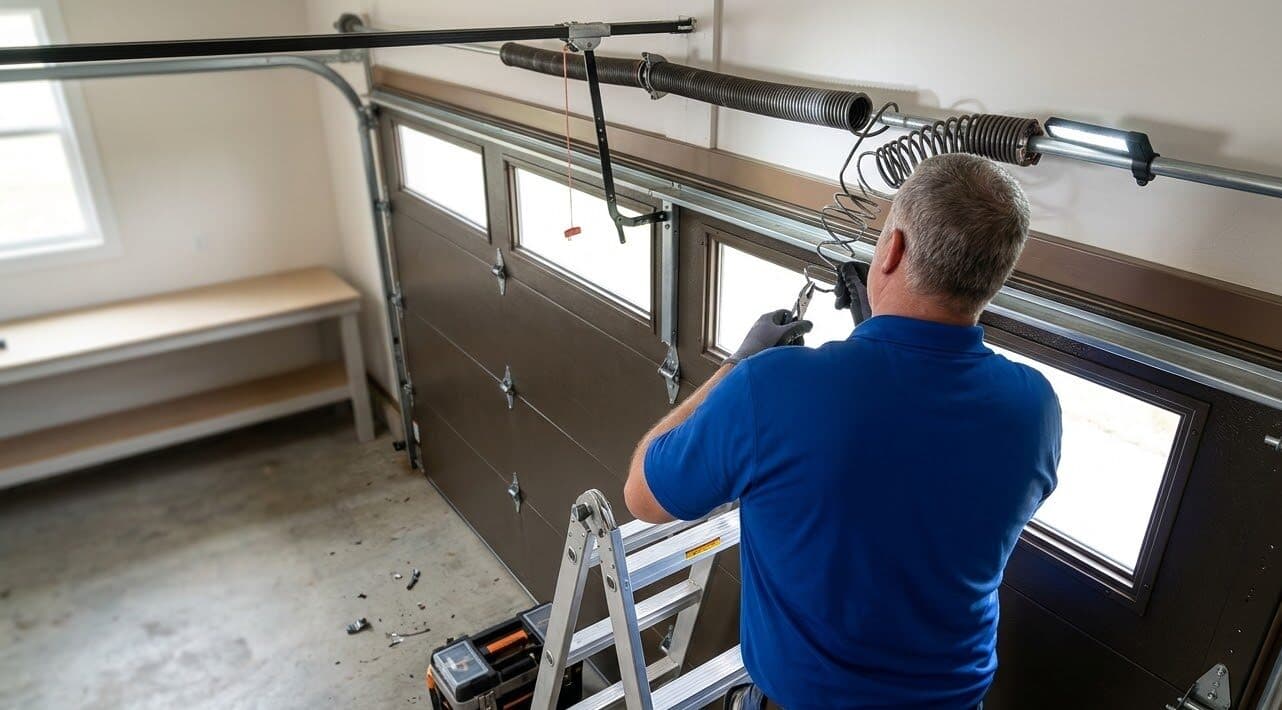
A torsion spring in good condition looks like one continuous, tightly wound coil of metal. When the spring breaks, the coil separates at the break point and the two halves unwind slightly, creating a visible gap. This gap is usually two to four inches wide and is easy to spot once you know what to look for.

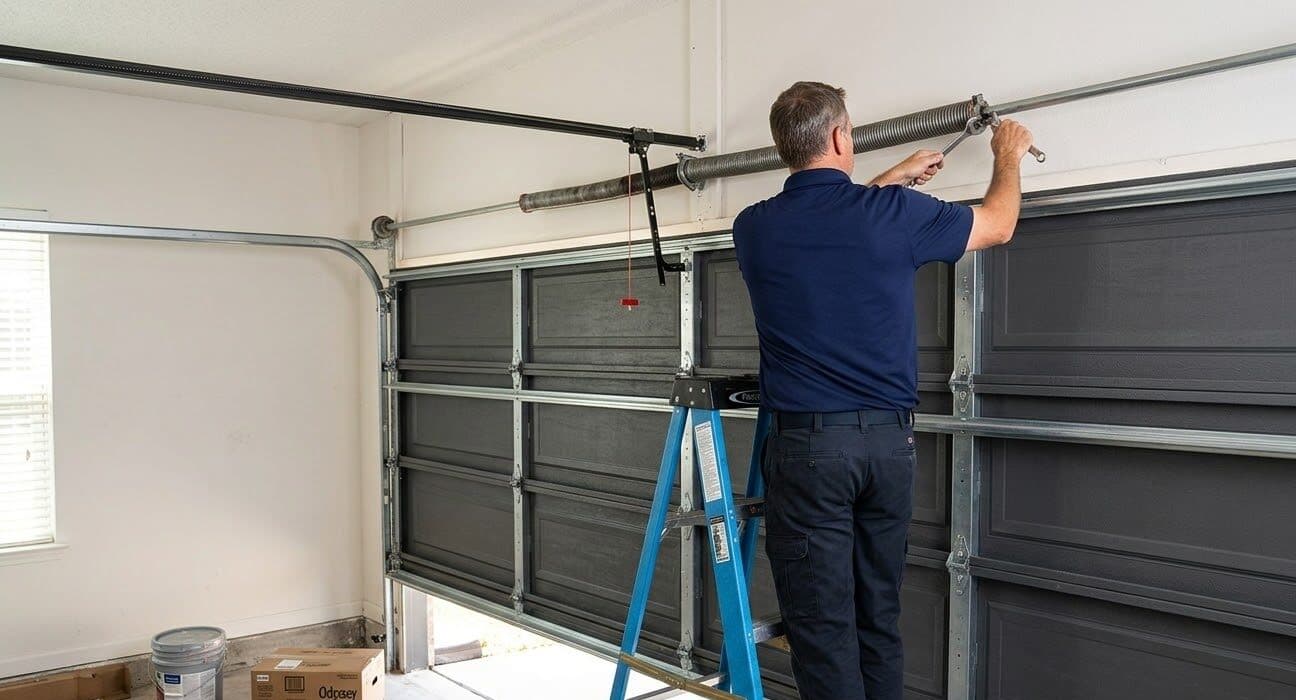
To check your springs, stand inside the garage with the door closed and look at the horizontal bar (torsion tube) mounted above the top of the door opening. The springs are the thick metal coils wrapped around this bar. If you see a gap or separation in either spring, that spring has failed and needs replacement.

Sometimes the break isn’t perfectly clean and the spring looks like it has a “stretched” section rather than a gap. This is still a broken spring. The metal has fatigued and separated, and the spring is no longer providing any lifting force. Do not attempt to touch, adjust, or remove a broken torsion spring yourself. These springs store enough energy to cause bone fractures, deep lacerations, and worse.

Rust, Corrosion, and Stretched Springs in Florida Humidity

Polk County’s humid subtropical climate is hard on garage door springs. Humidity levels regularly exceed 80%, and morning condensation forms on metal surfaces inside the garage throughout the year. That constant moisture exposure causes rust and corrosion that weakens the spring metal from the outside in.

Inspect your springs visually every few months. Healthy springs have a consistent dark finish with no rough patches, flaking, or orange-brown discoloration. If you see rust forming on the coils, it means the protective coating has broken down and the metal is corroding. Rusty springs have reduced elasticity and are significantly more likely to snap without warning.

Stretched or elongated coils are another warning sign unique to Florida’s heat. When temperatures inside your garage climb above 100 degrees (common in summer months), the metal expands and the spring can slowly lose its temper over time. Springs that look “looser” or have wider gaps between coils than they used to are losing their lifting power and approaching failure. Regular lubrication with a silicone-based spray every three to four months can slow corrosion and extend spring life by one to two years.

Your Opener Is Straining to Move the Door

A garage door opener is designed to move a balanced door, not to lift the full weight of the door on its own. When springs weaken gradually (rather than snapping all at once), the opener has to work harder and harder to move the door. You’ll notice the symptoms getting worse over weeks or months: the door moves slower, the motor runs longer, or the door reverses partway up.

Listen to your opener the next time you use it. A properly balanced door with healthy springs produces a smooth, steady motor sound from start to finish. A door with weakening springs makes the motor strain, slow down near the top of the travel, or produce a louder, higher-pitched whine. Some openers have an auto-reverse feature that kicks in when the door feels too heavy, causing the door to open a few feet and then close again.

This gradual decline is actually more dangerous than a sudden snap because homeowners adapt to it and assume the opener is wearing out rather than suspecting the springs. By the time the opener can no longer compensate, you’re looking at spring replacement plus potential opener damage. If your opener sounds different than it did six months ago, have the springs tested. A spring balance test takes five minutes and can save you hundreds in avoided opener repairs.

How Long Springs Last in Polk County and When to Replace Proactively

Standard torsion springs are rated for 15,000 to 20,000 cycles, where one cycle equals one full open-and-close operation. For a household that uses the garage door four times per day, that works out to roughly 10 to 14 years. High-cycle springs rated for 25,000 to 50,000 cycles are available and worth the upgrade if you use your garage door frequently.

In Polk County, real-world spring life is often shorter than the manufacturer rating. Florida’s heat, humidity, and temperature swings cause metal fatigue faster than in moderate climates. Springs that might last 12 years in Ohio or Colorado often last seven to nine years in Central Florida. If your springs are approaching the seven-year mark and you haven’t had them inspected, now is the time.

Proactive replacement makes sense once springs are past 70% to 80% of their expected cycle life. Replacing springs on your schedule (during a convenient weekday morning) costs the same as replacing them after they snap (often on a weekend or holiday when you’re trapped in or out of your garage). Rocket Garage Door Services performs free spring inspections for homeowners across Winter Haven, Lakeland, Bartow, and all of Polk County. Call us at (863) 624-3191 to schedule yours before a surprise failure disrupts your week.

FAQ

Frequently Asked Questions

How long do garage door springs last in Florida?

+
Standard torsion springs are rated for 15,000 to 20,000 cycles, which translates to about 7 to 12 years depending on usage. Florida heat and humidity can shorten spring life compared to cooler, drier climates. High-cycle springs rated for 25,000 to 50,000 cycles last significantly longer.

Can I replace a garage door spring myself?

+
Spring replacement is one of the most dangerous DIY home repairs. Torsion springs store enough energy to cause severe injuries, and roughly 10,000 emergency room visits per year in the United States are linked to garage door accidents. Always hire a trained technician for spring work.

How much does garage door spring replacement cost?

+
Torsion spring replacement in Polk County typically costs $150 to $350, while extension springs run $120 to $200 per spring. Replacing both springs at once (recommended) keeps total cost lower than two separate service calls.

Should I replace both garage door springs at the same time?

+
Yes. When one spring breaks, the other has the same number of cycles and will fail soon. Replacing both springs during the same service call saves you the cost of a second trip and prevents a second failure within weeks or months.

Does Rocket Garage Door Services offer emergency spring replacement?

+
Yes, we provide same-day and emergency spring replacement across Polk County, including Winter Haven, Lakeland, and surrounding communities. Call (863) 624-3191 and we will get a technician to your home as quickly as possible.
Service Areas

Main cities we serve

Based in Winter Haven, covering every major city in Polk County. Click any city for local service details.

Need a Garage Door Fixed?

Same-day service. Lifetime warranty on springs. Transparent pricing. Call now or book service online.