

Garage Door Spring Replacement in Winter Haven, FL
Torsion and extension spring replacement in Winter Haven, FL. High-cycle springs sized to your door weight. Call Rocket at (863) 624-3191.
Call (863) 624-3191When a garage door spring breaks in Winter Haven, FL, you know it. There’s a loud bang, and the door won’t budge. Rocket Garage Door Services handles garage door spring replacement across Winter Haven and Polk County, and we carry the most common torsion and extension springs on our trucks for same-day repairs. Our shop is right here in Winter Haven at 900 Orchid Springs Dr, so response times are fast.
 (863) 624-3191GET IMMEDIATE SERVICE!
Garage Door Spring Replacement in Winter Haven's Heat and Humidity
Spring failures happen more often in Central Florida than most homeowners expect. The combination of extreme heat, constant humidity, and the thermal cycling that comes with our climate creates conditions that shorten spring life by 20 to 30 percent compared to northern states. We replace springs in neighborhoods across Winter Haven every week, from the older homes near Lake Howard to the newer builds in the developments along Highway 27.
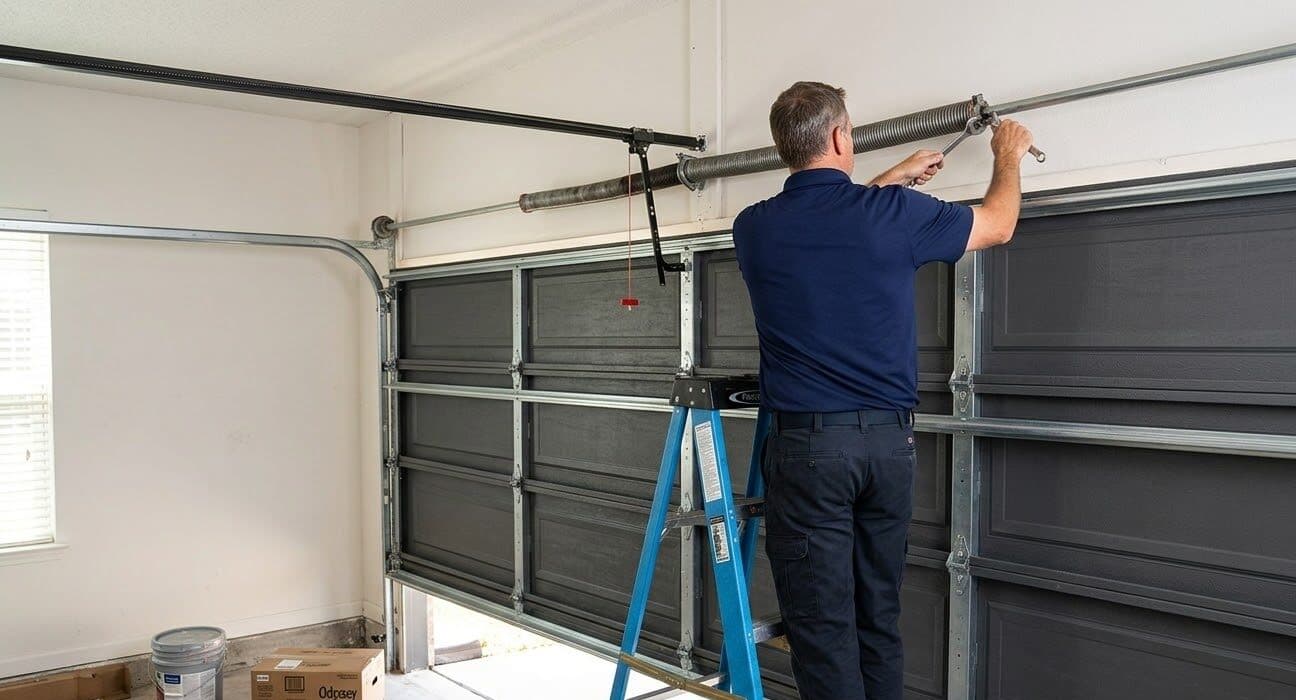
This isn't a job for weekend DIY. Torsion springs hold enough stored energy to cause serious injury or death if handled incorrectly. The winding cones, the set screws, and the tension bars all require specific techniques that our technicians train on extensively. Every spring we install gets precisely matched to your door's weight and size.
How Florida's Climate Destroys Garage Door Springs Faster
A standard torsion spring is rated for about 10,000 cycles. One cycle is one open and one close. If you use your garage door four times a day, that's roughly 1,460 cycles per year, which should give you about seven years of service. But that math assumes moderate temperatures and low humidity.
Winter Haven isn't moderate. Summer temperatures push garage interiors well past 130 degrees most afternoons. At night, temps drop into the 70s. That 50-to-60-degree daily swing causes the spring steel to expand and contract constantly. Each expansion and contraction introduces microscopic stress fractures in the wire. Over thousands of cycles, those tiny cracks join together and the spring snaps.
Humidity makes it worse. Winter Haven sits among more than 50 lakes, and the Chain of Lakes system means moisture is always in the air. Average relative humidity hovers around 74% year-round. That moisture causes surface rust on uncoated springs. Rust doesn't just look bad; it creates pitting in the wire surface that acts as a stress concentrator. A pitted spring will break at a lower cycle count than a clean one every single time.
We've pulled springs out of garages in the Preserve at Lakeside Landings and near Lake Elbert that were supposed to last seven years but broke after four. The proximity to the lake made the humidity problem even worse. If your home sits near one of Winter Haven's lakes, expect springs to wear out faster and consider upgrading to our high-cycle pair, which carries a lifetime warranty on the parts so any future spring failure costs you only the labor to replace it.
Torsion vs Extension Spring Systems for Your Garage Door
Not all garage doors use the same type of spring. The two main categories are torsion springs and extension springs, and they work very differently. Knowing which one you have affects the replacement process, the cost, and how long the new springs will last.
Torsion springs mount on a metal shaft directly above the garage door opening. They twist (torque) to store energy when the door closes, then release that energy to help lift the door open. Most double-car doors use a pair of torsion springs. Single-car doors often use one, though two is better for balanced operation. Torsion springs are the standard in newer Winter Haven construction, including the homes in Terranova, Elbert Hills, and the subdivisions built after 2000.
Extension springs run along the horizontal tracks on each side of the door. They stretch when the door closes and contract to pull it open. Extension springs are less expensive to buy and install, but they wear out faster and create more vibration. Many older homes in downtown Winter Haven, the Inwood area, and near Pughsville still have extension spring setups.
We recommend converting extension spring systems to torsion springs during replacement. The conversion costs a bit more upfront, but torsion springs last longer in Florida's climate, operate more quietly, and are safer because they don't fly across the garage if they break. Extension springs without safety cables can become dangerous projectiles. If your extension springs don't have safety cables running through the center, that's a safety issue we need to address.
(863) 624-3191GET IMMEDIATE SERVICE!
High-Cycle Spring Upgrades
Standard springs give you about 10,000 cycles. For a family that opens and closes the garage door four times a day, that works out to around five to seven years in Winter Haven's climate. But high-cycle springs are available in 25,000, 50,000, and even 100,000 cycle ratings.
A high-cycle pair installed is $1,200 with a lifetime warranty on the parts, an investment that pays back across the extended service life of a 25,000-cycle pair compared to a standard 10,000-cycle pair. For that extra cost, you get roughly triple the lifespan. That's a smart investment for homeowners who plan to stay in their house for more than a few years. We install a lot of 25,000-cycle springs in the 55-plus communities like Lake Ashton and Traditions at Lake Ruby, where homeowners want to avoid dealing with another spring replacement for as long as possible.
Every Rocket spring is oil-tempered with a rust-inhibitor coating, our standard install on every job. The coating slows the surface corrosion that eats through bare-wire alternatives in our humid climate. For homes near the Chain of Lakes or in low-lying areas where morning fog is common, the high-cycle pair upgrade is the strongest defense available, since the warranty covers the parts for life and any future failure only costs you labor.
For commercial properties and high-traffic residential garages, 50,000 or 100,000-cycle springs make financial sense. The cost per cycle drops dramatically at higher ratings, and the reduced maintenance is worth the upfront investment. We stock the most common residential sizes in standard and high-cycle options on our trucks.
Warning Signs Your Springs Are About to Fail
Springs rarely break without warning. There are several signs that your torsion or extension springs are nearing the end of their useful life. Catching these signs early lets you schedule a replacement on your terms instead of dealing with an emergency when your car is trapped inside.
The door feels heavier than it used to. Torsion springs lose tension gradually as the wire fatigues. If your door used to lift easily with one hand and now feels like you're fighting it, the springs are losing their stored energy. This is the earliest and most reliable warning sign.
The door doesn't stay open on its own. A properly balanced garage door should stay in place when you lift it halfway and let go. If it drifts down, the springs aren't providing enough counterbalance. This also puts extra strain on your opener motor, which can burn out prematurely.
You hear squeaking, grinding, or popping noises during operation. These sounds indicate the coils are rubbing against each other unevenly, which happens when the wire develops weak spots. Some noise is normal as springs age, but sudden changes in the sound pattern are a red flag.
Visible rust, especially on the inner coils. Surface rust on the outer coils is common in Winter Haven and can be addressed with lubricant. But rust on the inner coils where the wire wraps tightest means moisture has penetrated deep into the spring. Once the inner coils rust, failure is usually just weeks or months away.
The door opens unevenly. If one side lifts higher than the other, you may have one spring that's weaker than its partner. This creates uneven stress on the tracks, rollers, and cables, and can damage those components too if you don't address the spring issue.
Spring Sizing and Why Correct Matching Matters
Installing the wrong spring size on a garage door is a recipe for premature failure and potential safety problems. Springs are specified by three measurements: wire diameter, inside diameter, and overall length. These dimensions determine how much weight the spring can support and how many turns of tension it needs.
We measure your existing springs or weigh your door to determine the correct replacement spring specification. A spring that's too light for your door will stretch beyond its design limits and break early. A spring that's too heavy will overpower the door, making it fly up and slam against the stop, which damages the tracks and opener.
Door weight varies more than people think. A single-car uninsulated steel door might weigh 80 to 100 pounds. A double-car insulated steel door with windows can weigh 200 to 300 pounds. Wood doors and custom carriage doors are heavier still. The spring system needs to match the exact weight of your specific door, not just a general category.
In Winter Haven, we see a lot of homes where a previous repair company installed springs that were close but not exactly right. The door works, but the spring is overloaded by 10 or 15 percent. That overload translates directly to shortened lifespan. We size every spring to your door's actual measured weight, not to a chart.
Same-Day Spring Replacement Across Winter Haven and Polk County
A broken spring means your garage door isn't opening, and that's a problem you can't wait days to solve. Your car might be stuck inside. Your home security is compromised with the door unable to close properly. And in Winter Haven's rain, an open garage means water damage to everything you store in there.
We offer same-day spring replacement for most calls received before noon. Our trucks carry the most common residential spring sizes in both standard and high-cycle options, so we can usually complete the job in a single visit. For unusual spring sizes or commercial applications, we may need to source the correct spring, but we keep turnaround to 24 hours or less.
We serve every neighborhood in Winter Haven, including Florence Villa, the homes along Lake Lucerne, the gated community at Renaissance, and the newer developments out toward the airport area. We also cover unincorporated Polk County areas surrounding Winter Haven, including the rural stretches along Highway 17 and the communities east of Cypress Gardens Boulevard.
Every spring replacement includes removing the old springs, installing new matched springs, adjusting the cable drums and tension, lubricating all moving parts, and testing the door through multiple cycles. We also inspect the cables, rollers, and tracks while we're there because a broken spring often stresses other components. If we find anything else that needs attention, we'll let you know before doing any additional work.

Other cities near Winter Haven
Based in Winter Haven, covering every major city in Polk County. Click any city for local service details.
Other garage door services we offer
Garage Door Spring Replacement
Garage door spring replacement in Winter Haven and Polk County, FL. Torsion and extension springs replaced sam
Learn MoreGarage Door Repair in Polk County, FL
Fast garage door repair in Winter Haven and Polk County, FL. Broken springs, cables, openers, and panels fixed
Learn MoreGarage Door Opener Repair
Garage door opener not working? Same-day opener repair in Polk County, FL. All brands serviced. Diagnostic and
Learn MoreGarage Door Opener Installation
Garage door opener installation in Polk County, FL. LiftMaster, Chamberlain, and smart openers. Professional s
Learn MoreGarage Door Installation in Polk County, FL
New garage door installation in Winter Haven and Polk County, FL. Insulated, hurricane-rated, and custom doors
Learn MoreEmergency Garage Door Repair
Emergency garage door repair in Winter Haven and Polk County, FL. Available 7 days a week for urgent repairs.
Learn MoreOther garage door services in Winter Haven
Emergency Garage Door Services in Winter Haven, FL
Door stuck, spring snapped, or storm damage? Winter Haven techs answer 24/7 and fix most doors the same night.
Learn MoreGarage Door Installation in Winter Haven, FL
New garage door installation in Winter Haven, FL. Steel, insulated, and custom doors with storm-rated options.
Learn MoreGarage Door Opener Installation in Winter Haven, FL
Garage door opener installation in Winter Haven, FL. Belt, chain, and direct-drive systems with battery backup
Learn MoreGarage Door Opener Repair in Winter Haven, FL
Garage door opener repair in Winter Haven, FL. Logic board, capacitor, gear, and sensor fixes same day. Call R
Learn MoreGarage Door Repair in Winter Haven, FL
Garage door repair in Winter Haven, FL. Broken springs, off-track doors, cables, and rollers fixed same day. C
Learn MoreFrequently Asked Questions
How do I know if my garage door spring is broken in Winter Haven?
+
Why do garage door springs break faster in Polk County's climate?
+
Should I replace one spring or both at the same time?
+
How long does a spring replacement take in Winter Haven?
+
What's the difference between torsion and extension springs for Winter Haven homes?
+
Articles and guides for homeowners
How to Program Your Garage Door Opener to Your Car in 2026
<p style="font-size: 17px; line-height: 1.7;">The garage button in your car usually learns your remote on the first try and still does not open the door. That is because every rolling code opener needs a second step: pressing the Learn button on the motor and sending the car signal within about 30 seconds. Here is the full HomeLink sequence in the order it has to happen, how to read the indicator light, the repeater fix for Security+ 2.0 openers and older cars, how to erase HomeLink before you sell a vehicle, and the Florida heat and storm issues that make you repeat it more often than you should.</p>
Read Article
How to Program a Genie Garage Door Remote (2026)
<p>Genie programming fails for a reason that has nothing to do with the remote: the company changed the motor head interface partway through the product line, and the two generations use opposite button behavior. On one, you press and hold. On the other, holding that same button erases every remote in the house. Add the 5 foot standing rule almost nobody follows, and you get a perfectly good remote that will not pair. Here is each procedure, for remotes and keypads, plus the six things that look like programming problems and are not.</p>
Read Article
How to Reset a LiftMaster Garage Door Opener (2026)
<p>Half the LiftMaster resets people perform do not address the symptom they are chasing, because four different procedures share the same name. Holding the Learn button wipes every remote in the house. Pressing and releasing it does the opposite and teaches a new one. Neither touches travel limits, which live on a different set of buttons entirely. And none of them clears the previous homeowner off the myQ account. Here is each procedure, what the LED is telling you at each step, and how to know which one your door actually needs.</p>
Read ArticleNeed a Garage Door Fixed?
Same-day service. Lifetime warranty on springs. Transparent pricing. Call now or book service online.