Two Ways to Lift the Same Heavy Door
A typical two-car steel garage door weighs well over 100 pounds, and some insulated or wind-rated doors weigh far more. The opener does not lift that weight. The springs do. When the system is balanced, the springs carry almost the entire weight of the door, and the opener or your hand only has to guide it up and down.
Residential garage doors use one of two spring systems to do that job: torsion springs or extension springs. They store energy in different ways, sit in different places, fail in different ways and call for different safety precautions. Knowing which one your door has helps you understand a repair quote, spot a problem early and decide whether an older system is worth upgrading. This guide shows you how to tell them apart in a few seconds and what each type means for your door.
How to Tell Which Springs Your Garage Door Has
Stand inside the garage with the door closed and look up. You do not need to touch anything, and you should not. Springs on a closed door are under maximum tension.
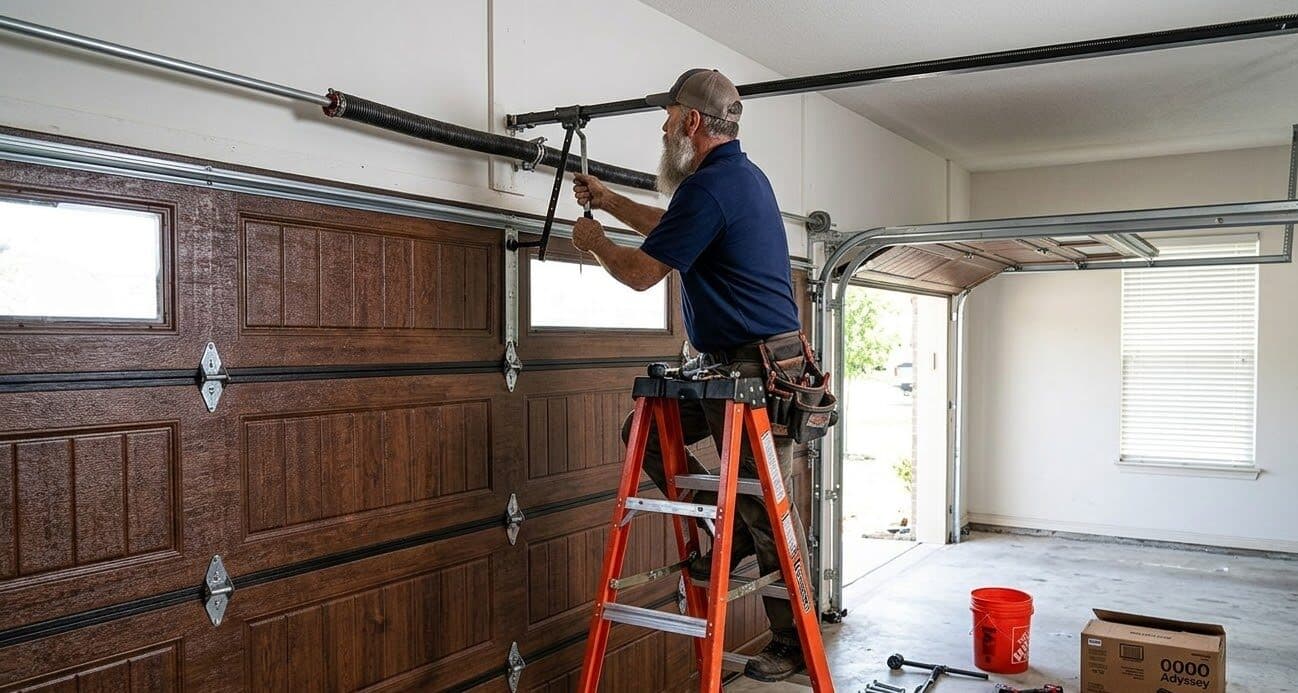
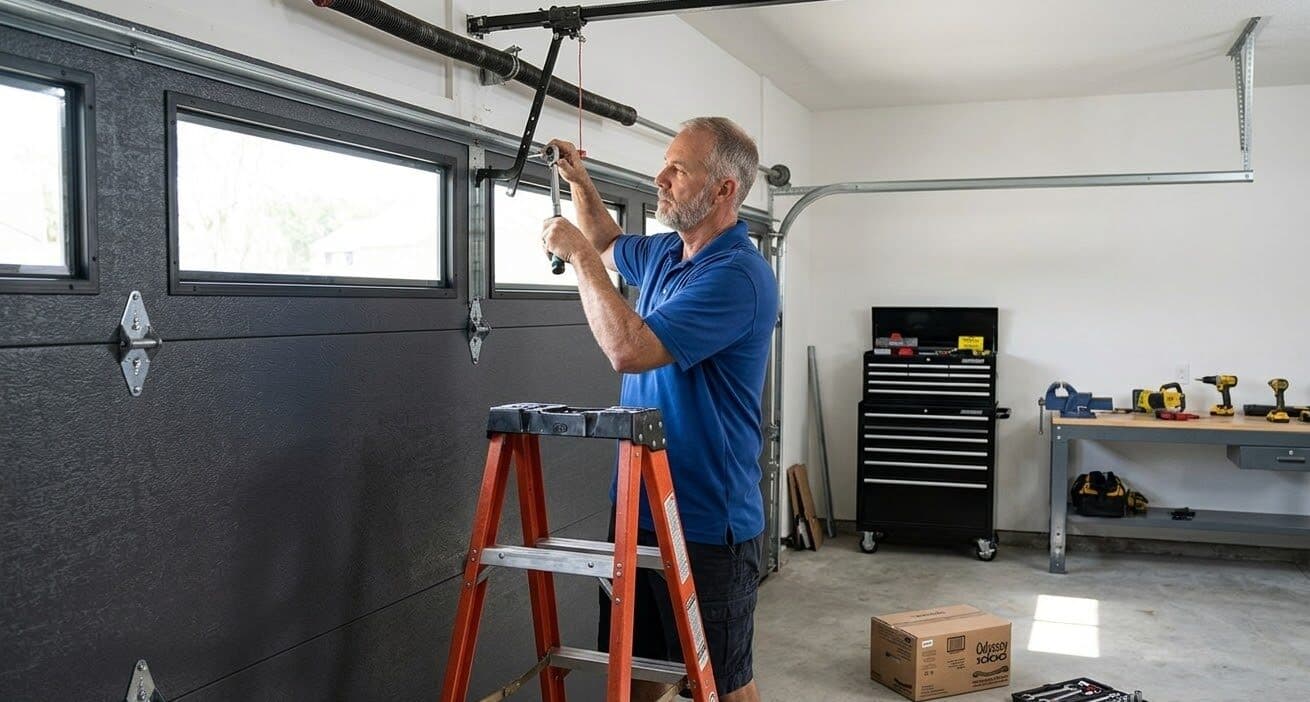
- Torsion springs: look directly above the top of the door opening. If you see one or two large coiled springs wrapped around a horizontal steel shaft that runs across the width of the door, with cable drums at each end of the shaft, you have torsion springs.
- Extension springs: look along the horizontal tracks on each side of the ceiling, running from the back of the tracks toward the door. If you see long springs stretched parallel to the tracks, usually with pulleys and cables, you have extension springs.
- Enclosed torsion systems: some doors, often Wayne Dalton TorqueMaster models, have the springs hidden inside a metal tube above the door. If you see a tube with no visible coils and a winding mechanism at one end, it is still a torsion system, just enclosed.
Also check how many springs there are. Many single-car doors and lighter double doors have one torsion spring, while heavier double doors usually have two. Extension systems always come in pairs, one on each side.
How Torsion Springs Work
A torsion spring stores energy by twisting. When the door closes, the cables wrapped around the drums at each end of the shaft unwind and turn the shaft, which winds the spring tighter. When the door opens, the spring unwinds, turns the shaft and winds the cables back onto the drums, lifting the door.
Because the force is applied through a single shaft across the full width of the door, both sides lift evenly. That is the main reason torsion systems give a smoother, more controlled movement. The springs are sized to the door's weight, height and track design by wire gauge, inside diameter and length, which is why a correct replacement starts with weighing the door and measuring the old spring, not guessing from the size of the garage.
- Where they are used: most newer residential doors in Polk County, and nearly all heavier insulated and wind-rated doors.
- Lifespan: standard torsion springs are commonly rated around 10,000 cycles, and high-cycle springs are available with much higher ratings for busy households.
- When one breaks: you usually hear a loud bang, and you will often see a gap of a couple of inches in the coil above the door. The door may feel extremely heavy or the opener may lift it only a few inches.
- Adjustment: torsion springs are wound or unwound with steel winding bars inserted into the winding cone. This is the most dangerous adjustment on a garage door and should only be done by a trained technician.
How Extension Springs Work
An extension spring stores energy by stretching. When the door closes, cables running over pulleys pull the springs along the horizontal tracks, stretching them. When the door opens, the springs contract and pull the cables, which lift the door.
Extension systems are simpler and cheaper to build, which is why they show up on older homes, lighter doors and some builder-grade installations. Because each side has its own spring, the two springs need to be closely matched. If one is weaker, the door can rise unevenly and wear the rollers and tracks on one side.
- Where they are used: older homes, lighter single-layer steel doors and some lower-cost installations.
- Lifespan: extension springs are commonly rated around 10,000 cycles, similar to standard torsion springs, but more parts in the system, such as pulleys and cables, wear along with them.
- When one breaks: the door usually rises crooked or will not lift at all, and the broken spring may hang loose from the track.
- Safety cables: every extension spring should have a containment cable, also called a safety cable, running through the center of the coil and anchored at both ends. If the spring snaps, the cable keeps the broken pieces from flying across the garage.
That last point is the most important thing to check on an extension system. If you look at your springs and see no cable running through the middle, the system is missing its main safety feature. A broken extension spring without containment can release enough energy to damage a car, a wall or a person standing nearby.
Torsion vs Extension Springs Side by Side
| Feature | Torsion springs | Extension springs |
|---|---|---|
| Location | On a shaft above the door opening | Along the horizontal tracks on each side |
| How they store energy | Twisting | Stretching |
| Typical doors | Most newer, heavier, insulated and wind-rated doors | Older and lighter doors |
| Door movement | Smooth and even on both sides | Can rise unevenly if springs are mismatched |
| When a spring breaks | Stays on the shaft | Needs a containment cable to stay contained |
| Number of springs | One or two | Always two |
| Space needed | Some headroom above the door | Space alongside and behind the tracks |
| Upfront part cost | Higher per spring | Lower per spring |
The price difference matters less than it looks. A proper extension spring job replaces both springs and checks the pulleys, cables and containment cables, which narrows the gap. Our guide to garage door spring replacement cost in Florida breaks down what each type costs in 2026.
Which Spring System Is Better?
For most homes, torsion springs are the better system. They balance the door more evenly, put less strain on the opener, stay on the shaft when they break and handle heavier doors well. Heavier insulated doors and wind-rated doors built for Florida hurricane code almost always use torsion springs for that reason.
Extension springs still make sense in a few situations:
- Low headroom: when there is very little space between the top of the door and the ceiling, a torsion system may not fit without a low-headroom kit.
- Lighter doors: on a light, non-insulated single door, a well-maintained extension system with containment cables works fine.
- Budget repairs: when only the springs are worn and the rest of the system is in good shape, replacing the extension springs is the less expensive fix.
If you are replacing the whole door, the new door will usually come with a torsion system sized to it. If you are only replacing springs, the existing system usually stays, unless it is worn across the board.
Converting From Extension to Torsion Springs
Many older Polk County homes still run on extension springs, and owners often ask whether to convert. Converting means removing the extension springs, pulleys and cables, then installing a torsion shaft, drums, bearing plates, springs sized to the door and new lift cables. It is a bigger job than a spring swap, and it costs more.
It is worth considering when:
- Several parts are worn: springs, pulleys and cables are all at the end of their life at the same time.
- The door runs unevenly: mismatched extension springs keep pulling one side ahead of the other.
- You are adding weight: such as insulation, window inserts or a heavier door, which may exceed what the extension system was designed for.
- Safety cables are missing: and the system needs to be rebuilt anyway.
A conversion is not worth it when the door itself is near the end of its life. In that case, put the money toward a new door with a properly sized torsion system.
What Florida Heat and Humidity Do to Each Type
Both types of springs are made from oil-tempered or galvanized steel wire, and both suffer in Florida's humidity. Rust roughens the surface of the coils and creates friction and weak points, which is where most springs eventually crack. Garages near lakes and in older homes without good airflow see it the most.
Torsion springs concentrate wear where the coils rub against each other as they twist, so a light coat of garage door lubricant on the coils a few times a year helps them last. Extension springs stretch and contract along their whole length, and their pulleys and cables add more parts that can rust and wear. Our article on how long garage door springs last explains how cycle ratings and Florida conditions affect spring life.
Safety: Why Spring Work Is Not a DIY Job
Garage door springs are one of the most dangerous parts of a home to work on. A wound torsion spring or a stretched extension spring holds enough stored energy to cause serious injury if a winding bar slips, a set screw is loosened in the wrong order or a cable is disconnected under tension.
- Do not: loosen set screws on a torsion spring, remove extension springs from their brackets or disconnect lift cables yourself.
- Do not: run the opener with a broken spring. The opener is not built to lift the full weight of the door, and it can strip gears or pull the door off its tracks.
- Do: look, listen and call. A visual inspection from the floor is safe, and so is noticing a door that feels heavier or rises crooked.
- Do: ask the technician to show you the wire size and cycle rating on the new springs, so you know what you paid for.
If you are not sure whether your springs are still healthy, our guide to the signs you need garage door spring replacement lists what to look and listen for.
Get Your Spring System Checked in Polk County
Rocket Garage Door Services repairs and replaces torsion and extension springs, installs containment cables and converts worn extension systems to torsion across Lakeland, Winter Haven, Bartow and the rest of Polk County. Our garage door spring replacement service starts by weighing the door and identifying the system, and our garage door balance adjustment keeps the door from straining the opener. Homeowners can book spring replacement in Lakeland, spring replacement in Winter Haven or spring replacement in Bartow.
Call (863) 624-3191 and tell us what you see above your door. We will tell you which system you have, whether it is safe, and what makes sense for your door and budget.