

What a Carriage House Garage Door Actually Is
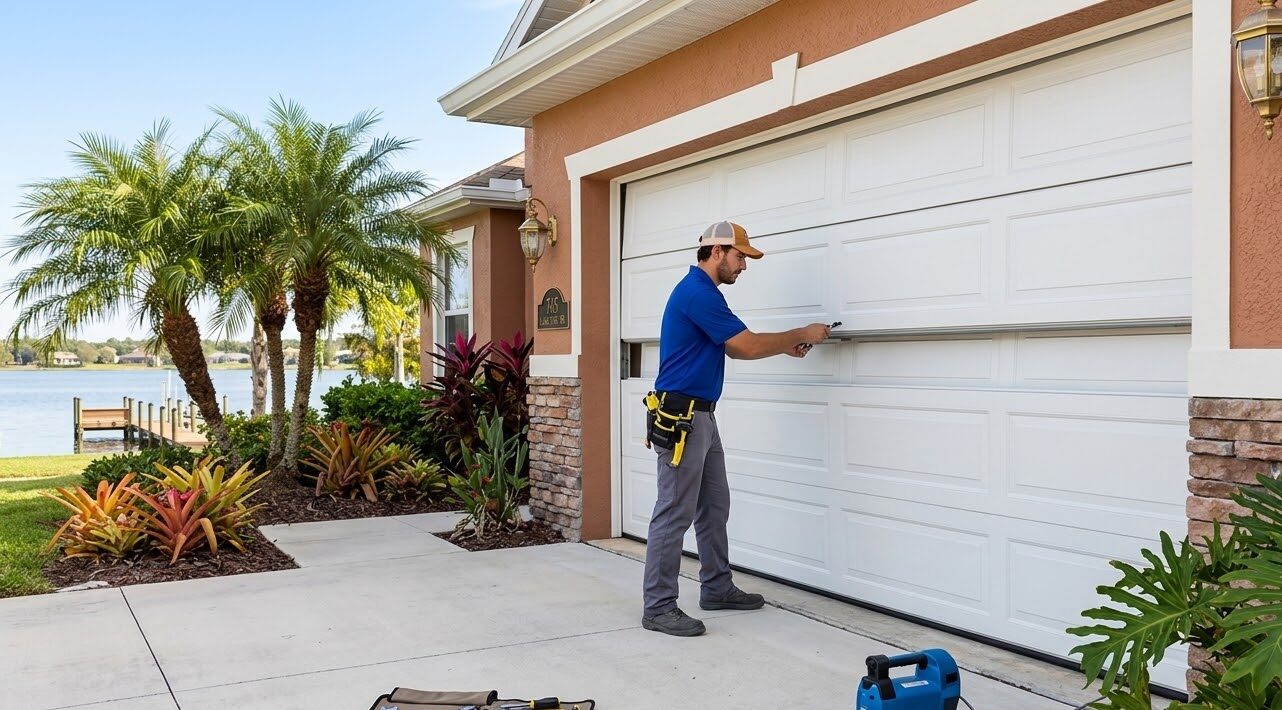
Three different products get sold under the same name, and the price differences between them make no sense until you know which is which.
- True swing-out carriage doors: Two leaves hinged at the jambs, opening outward like barn doors. Authentic, expensive, and rare in Florida. They need clear space in front of the opening, which conflicts with the short driveways common in Central Florida subdivisions, and they require specialty operators rather than a standard overhead opener.
- Carriage-style sectional doors: A conventional sectional overhead door with a carriage face. Overlay boards applied to an insulated steel base, decorative handles and hinges, and usually windows in the top section. This is what almost every Florida installation actually is, and it is the version that gets a Florida Product Approval as a tested assembly.
- Stamped carriage-look steel: The pattern is pressed into the steel skin rather than applied as a separate layer. The cheapest entry into the look, and the version most likely to read as imitation from close range, because the shadow lines are shallow.
The practical takeaway is that in Florida you are choosing between the second and third options, and the entire question is how convincing the face is and how well it holds up. Nothing about the mechanics changes. It is still a sectional door on tracks with torsion springs and an overhead opener, which is why it can carry a wind rating and why it fits a standard Florida garage opening.
What Carriage House Doors Cost in 2026

Pricing sorts cleanly once you stop comparing across construction types.
- Carriage house doors, installed: Commonly $2,500 to $6,500 for the full range of quality levels, against $1,200 to $2,800 for a comparable insulated steel door in a flat or raised panel design. That is roughly two to four times the plain door.
- Decorative overlay premium: On the same base door, adding carriage overlays runs about $300 to $1,000 more than a comparable flat or raised-panel face. This is the honest way to isolate what the look itself costs when the rest of the specification stays constant.
- Custom solid wood, double car: $8,000 to $12,000 or more. This is the version people picture, and it is also the version with the shortest maintenance interval in this climate.
- Insulation package: Double-layer and triple-layer construction with polyurethane or polystyrene fill adds $150 to $600 or more to the door cost. It also improves rigidity and quiet operation, which matter on a heavy door.
Notice how those numbers stack. A $6,500 carriage door and a $2,800 flat steel door are frequently the same base door with a different face and a better insulation package. That is useful leverage in a quote conversation, because it means you can ask a dealer to price the same base with and without the overlay and see the real number rather than the bundled one.
If your existing door is structurally sound and the goal is purely appearance, it is worth pricing the alternative first. We ran that comparison in detail in our guide to garage door painting versus replacement in Florida, and on a door under about ten years old the answer is not always replacement.
The Overlay Substrate Decides Everything

This is the section that saves money. Two carriage doors that look identical in a showroom photograph can be built from completely different overlay materials, and in Florida the material decides the maintenance schedule.
- Composite overlay on insulated steel: The mainstream Florida answer. Engineered material that does not absorb moisture the way solid wood does, applied over a steel base that carries the structure and the rating. Holds paint, resists swelling, and does not telegraph grain movement through the finish.
- PVC or polymer overlay: The most moisture-immune option. Completely unaffected by humidity, though the material reads slightly flatter than composite or wood at close range and can be more sensitive to color fade under direct Florida sun depending on the finish.
- Real wood overlay on steel: Authentic grain and shadow, with the structure still carried by the steel underneath. The compromise most people are actually looking for, and it still requires refinishing on a Florida schedule.
- Solid wood construction: The full custom version, priced accordingly, and the one that changes dimension with the seasons in this climate.
The mistake that costs the most is buying a wood or wood-overlay door for a west-facing or south-facing opening without budgeting the refinishing. Direct Florida sun plus daily humidity swings is the hardest exposure a painted or stained surface faces on a house, and a garage door is a large flat plane pointed straight at it.
Why Solid Wood Is a Hard Sell in Central Florida
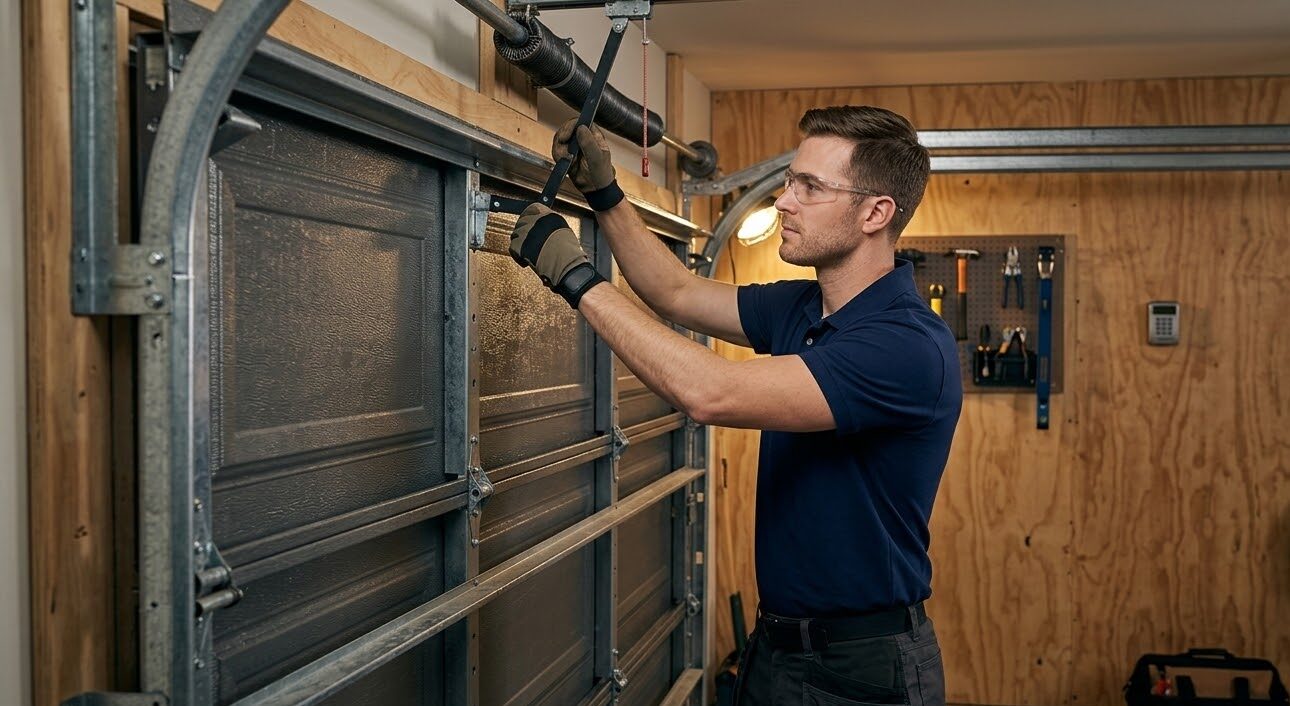
Solid wood is the most beautiful version of this door and the one we talk homeowners out of most often. The reason is moisture, not durability.
Wood absorbs and releases moisture with the ambient humidity, and it does so unevenly across a large panel that is warm on one face and cool on the other. In Central Florida, where humidity is high most of the year and the garage interior is usually unconditioned, that gradient runs across the door continuously. The result over several years is dimensional movement: joints open slightly, panels cup, finish checks, and the door that closed perfectly in year one starts binding at the jamb.
The failure is gradual and it does not usually stop the door from working. What it does is make the door look neglected while the mechanism is fine, which is the opposite of the reason people bought it.
If solid wood is non-negotiable, three things make it survivable. Choose a species and construction rated for exterior use rather than a decorative panel. Commit to a refinishing schedule and treat it as ownership cost, not as a repair. And make sure the door is fully sealed on all six faces including the top and bottom edges, which is the most commonly skipped step and the one that lets moisture in fastest.
Insulation: The Layer Nobody Compares
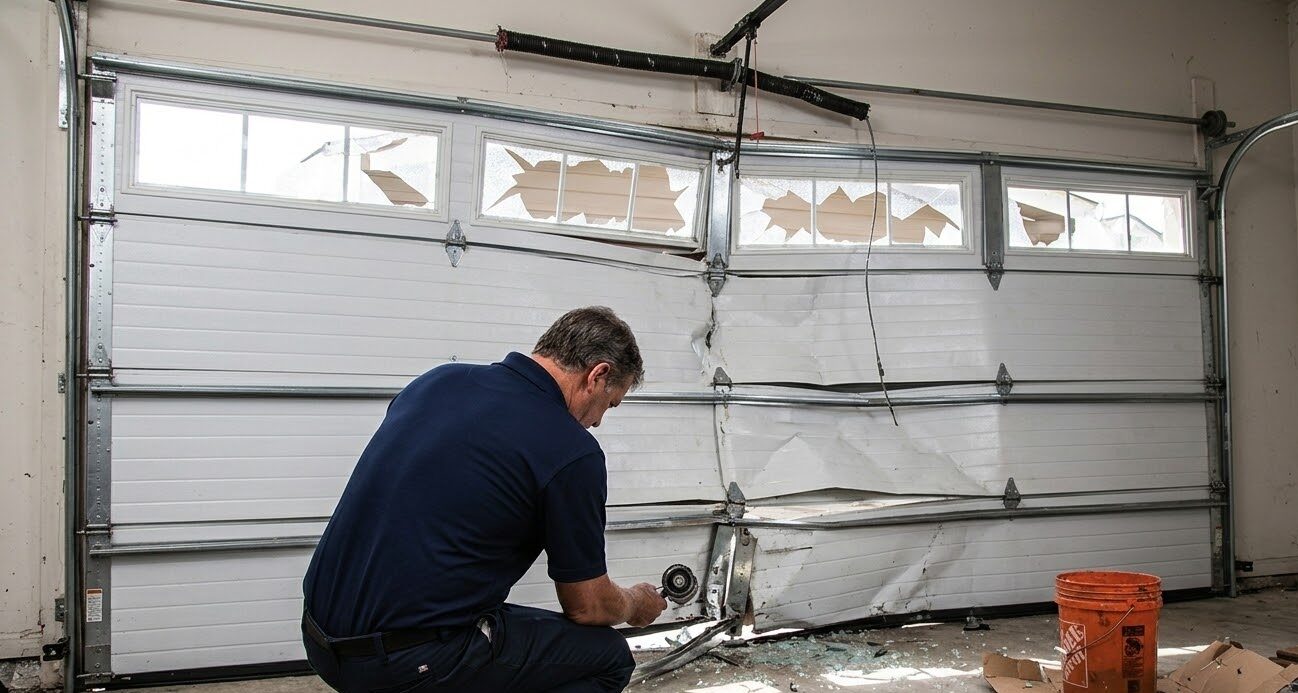
Carriage doors are shopped on appearance and specified on construction, and the insulation package is where two similar-looking quotes actually differ.
A double-layer or triple-layer door with polyurethane or polystyrene fill costs $150 to $600 or more over a single-layer equivalent, and it does three jobs at once. It reduces heat transfer into the garage, which matters in a state where an attached garage shares a wall with conditioned space. It stiffens the door, which reduces flex and makes the overlay less likely to develop stress at the joints. And it quiets the operation, which is more noticeable on a heavy carriage door than on a light flat one.
The point that gets missed is the second one. On an overlay door, panel rigidity is not just a comfort feature. A single-layer steel section flexes more in operation, and that movement works on the adhesive and fasteners holding the overlay boards. A stiffer double or triple layer section is a better substrate for the exact thing you paid extra for. The full breakdown of what each insulation level actually returns in this climate is in our Florida insulated garage door R-value guide.
Hardware, Handles and the Detail That Reads Fake
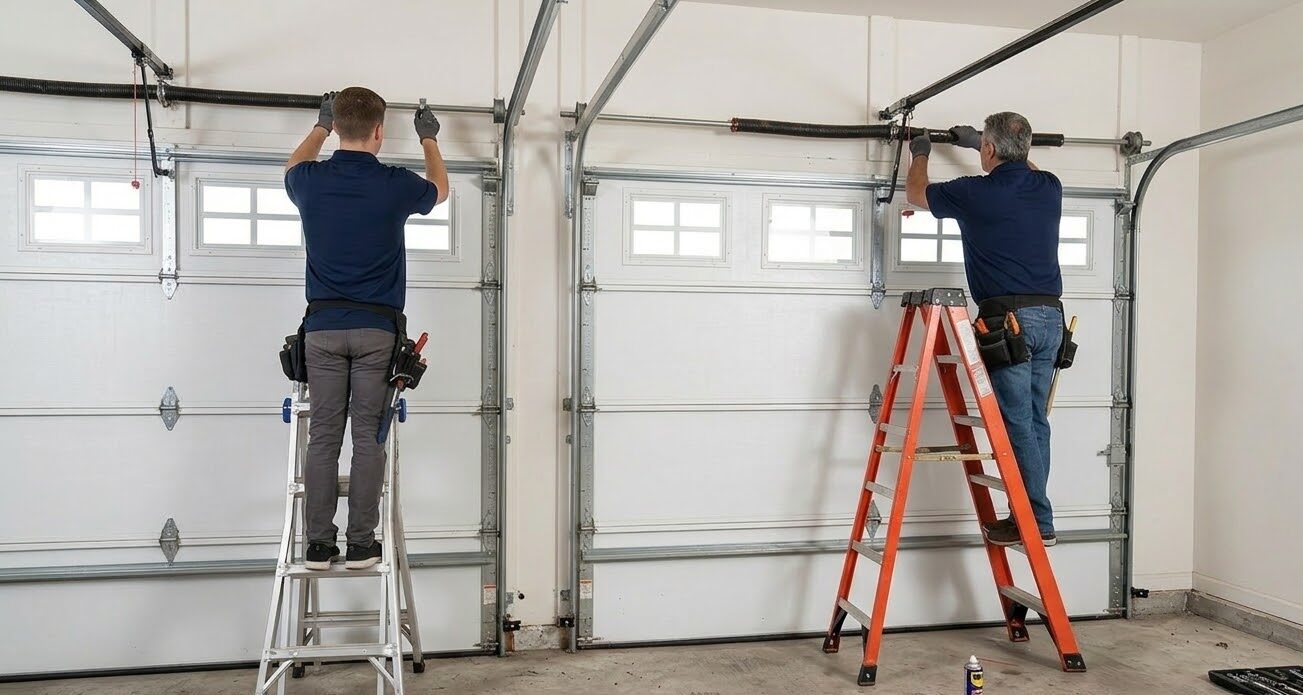
The single biggest difference between a carriage door that looks authentic and one that looks applied is not the boards. It is the hardware and the proportions.
- Strap hinge length: Decorative straps that are too short for the panel width are the most common tell. On a real swing door the strap reaches well toward the center of the leaf because it is carrying load. Scaled correctly, it reads right even though it carries nothing.
- Handle placement: Handles belong where they would be on a door that opens outward from the center, which means at the meeting point of the two visual leaves rather than centered in a panel.
- Finish consistency: Hardware finish should relate to the entry door hardware, the exterior lighting and any shutter hardware. Mismatched blacks and bronzes are noticeable at street distance even when the individual pieces are good.
- Overlay shadow depth: Applied overlay creates a real shadow line. Stamped steel creates a shallow one. From the sidewalk the difference is the whole effect, which is why the cheapest version of this look photographs better than it lives.
None of these items add meaningfully to the price. They are specification choices, which means they are free to get right at order time and expensive to correct after the door is hanging.
Windows in a Carriage Door: Almost Always Yes, With One Condition
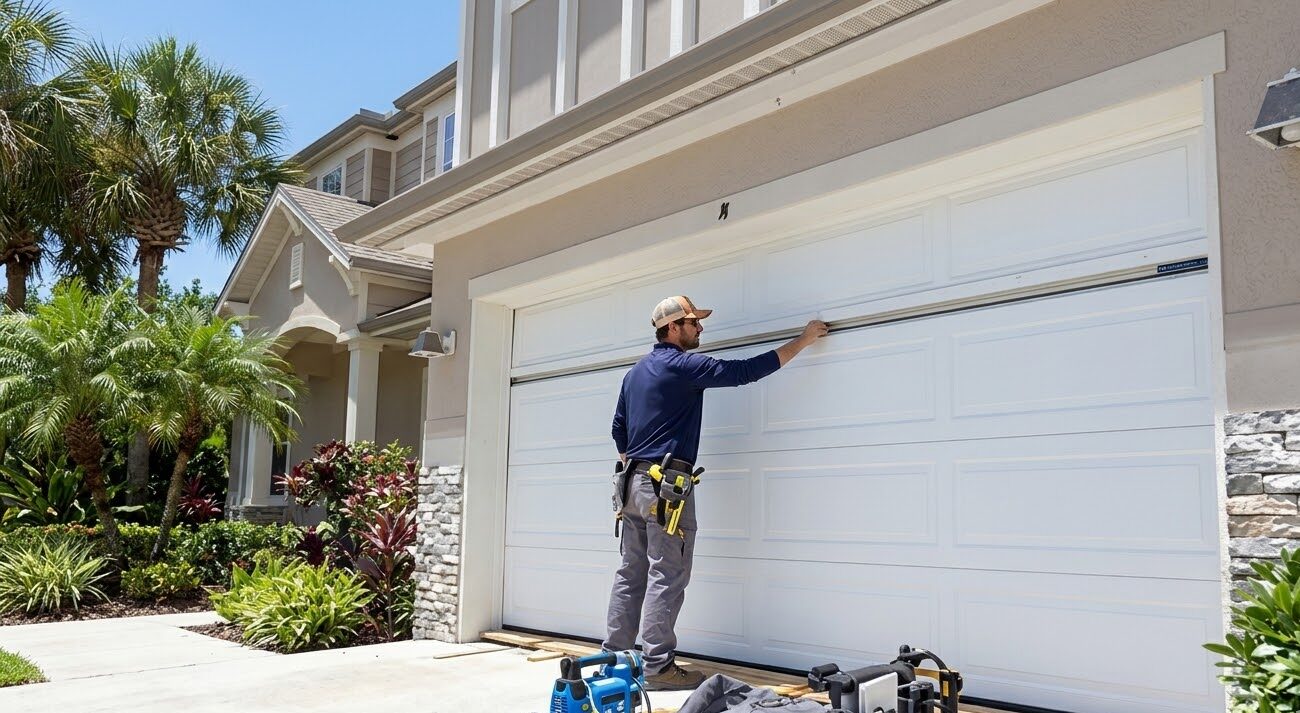
A row of windows in the top section is close to standard on this style, and it does more for the carriage effect than any other single option because it breaks up the flat plane.
The condition is that in Florida the garage door is a rated structural product and the rating belongs to a tested configuration. Ordering the door with the glass as a factory option keeps it inside that tested configuration. Cutting glass into a door that was approved solid is a different situation entirely, and it is the one place where a decorative decision has a code consequence. We covered the approval mechanics, the glazing materials that survive Florida ultraviolet, and the spring recalculation that follows in our guide to garage door window inserts in Florida.
For a new carriage door the practical rule is simple: specify the windows on the original order. The factory add cost is modest, the configuration stays approved, and the door arrives balanced for its actual weight.
What the Resale Numbers Actually Say
Garage door replacement has an unusually strong reputation in remodeling economics, and for once the reputation is supported.
In the 2026 Cost vs Value rankings, garage door replacement sits at the top of the national list at roughly 194 percent return, with an average job cost near $4,302 producing about $8,347 in added resale value. Regionally the figure is stronger. In the South Atlantic region, which includes Florida, the reported average job cost was $5,126 against $11,670 in resale value, a 228 percent recoup. More conservative sources put a midrange garage door replacement at roughly 90 to 100 percent of cost recovered, which is still among the best-performing exterior projects.
Two honest caveats. Those figures describe garage door replacement generally, not carriage doors specifically, so treat the carriage premium as a preference purchase rather than as a guaranteed multiplier on the return. And the numbers assume the door being replaced is dated or damaged. Replacing a five year old door in good condition with a nicer one does not produce the same effect, because the resale gain comes largely from removing a visible negative.
The version of this argument that holds up best in Central Florida is the listing one. The garage door is often 30 percent or more of the visible front elevation, and it is the first surface a buyer evaluates from the car.
HOA and Architectural Review in Central Florida
Carriage doors usually sail through architectural review, and the exceptions are predictable enough to check before ordering.
Boards in this region tend to care about three things: color against the approved palette, whether the style is consistent with the community's architectural theme, and whether windows are permitted on garage doors at all. Carriage styling is generally welcomed because it reads as an upgrade, but a dark stained wood-look door in a community of white and beige elevations can still get returned.
The sequence that avoids trouble is boring and effective. Get the manufacturer's specification sheet and a color sample before submitting rather than a catalog page. Submit before ordering, not before installing, because a custom carriage door is frequently non-returnable. And confirm whether your community requires the submission before or after permitting. The full process, including what documentation Florida boards typically ask for, is in our guide to HOA garage door rules in Florida.
Weight, Springs and the Recalculation Nobody Does
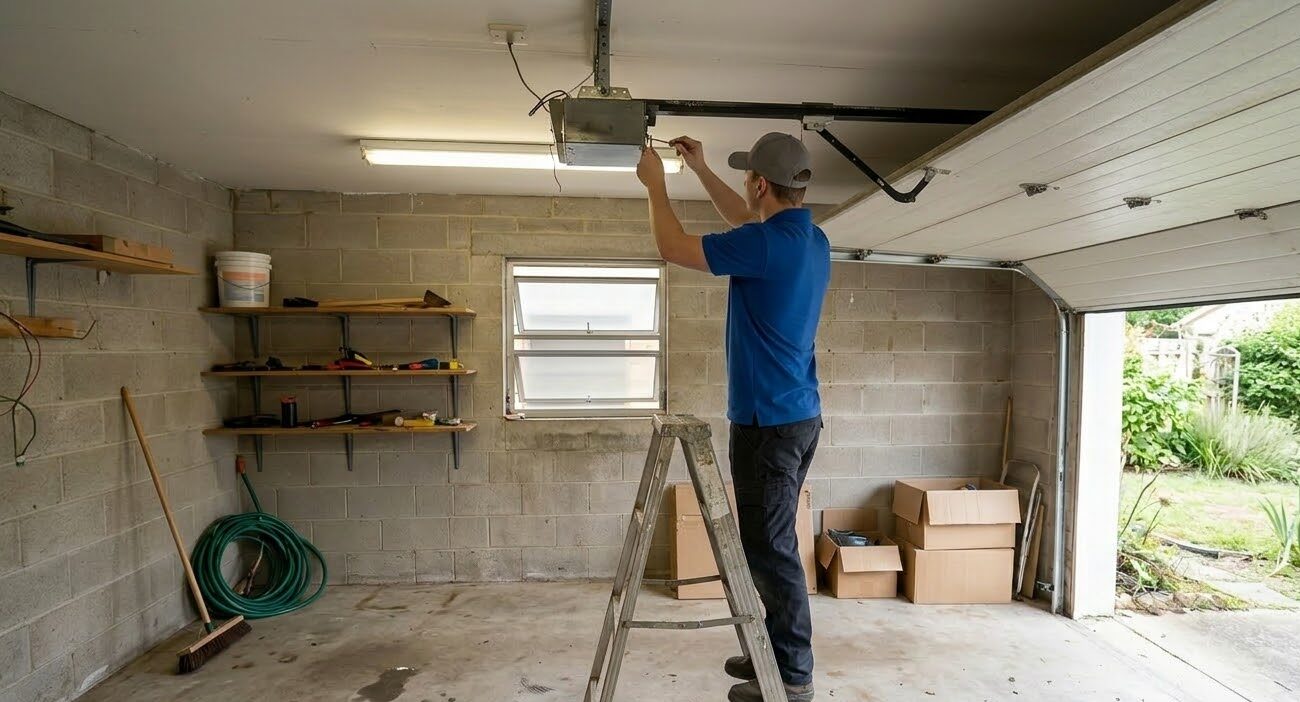
Overlay boards, decorative hardware and glass all add weight to a door, and a garage door is a counterbalanced system rather than a lifted one. The torsion springs are sized to the door's actual weight, and the opener is designed to guide a balanced door rather than to haul an unbalanced one.
On a new carriage door this is handled at the factory, because the door ships as a complete assembly with springs matched to its weight. The problem appears when a door is modified after the fact: overlays added, windows cut in, or heavier hardware installed on an existing door. In those cases the springs no longer match, the opener carries load it was not designed for, and the failure shows up as premature opener wear or a door that drifts instead of holding position.
The test takes thirty seconds. With the door about halfway open and the opener disconnected at the emergency release, a properly balanced door stays where you leave it. If it drifts down or climbs, the balance is off and the springs need adjustment before anything else gets diagnosed. If yours does that, it is a garage door spring replacement question rather than an opener question, and it is not a homeowner repair because torsion springs are under extreme tension.
How to Buy a Carriage Door Without Overpaying
Six questions turn a vague showroom conversation into a comparable quote.
- What is the base door? Ask for the same base priced with and without the carriage overlay. That isolates the $300 to $1,000 style premium from everything else.
- What is the overlay made of? Composite, PVC, wood overlay on steel, or solid wood. This single answer predicts the maintenance schedule for the next fifteen years.
- How many layers? Single, double or triple, and what the fill is. Insulation buys rigidity as well as R-value on an overlay door.
- What is the Florida Product Approval number? Matched to the wind speed at your address, with the windows included in the configuration if you are ordering them.
- Is the hardware scaled to the panel? Ask to see the strap length against the door width in a real installation photo rather than a rendering.
- What is the finish warranty and what voids it? On wood and wood-overlay doors, read the maintenance requirement, because the warranty usually depends on you meeting it.
Rocket Garage Door Services installs carriage-style and custom doors across Polk County, including Lakeland and Winter Haven, and we specify the base door and the balance before anyone talks about overlay patterns. See the options on our custom garage door and garage door installation pages, call (863) 624-3191, or start on the contact page and we will measure the opening and check the existing balance before quoting anything.


