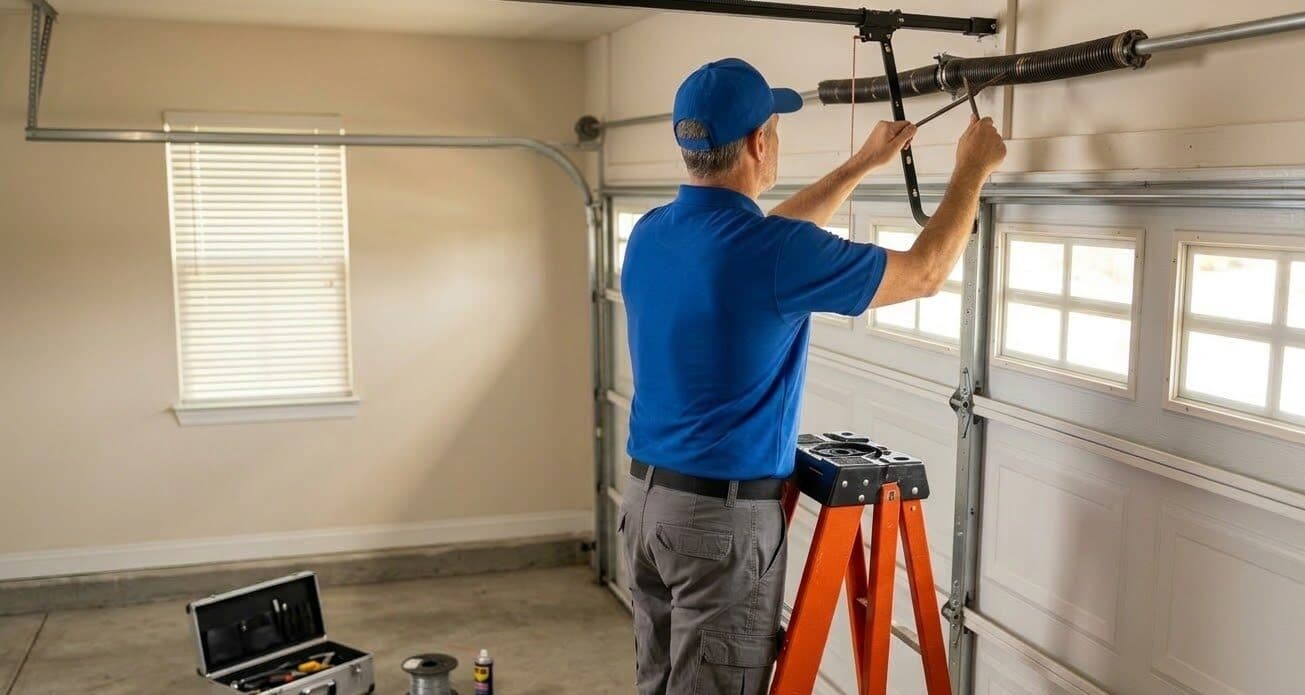
A Door That Stops Halfway Is Telling You Where the Problem Is
This is the most diagnosable garage door complaint there is, and most people throw away the information it hands them. A door that will not move at all could be a dozen things. A door that runs partway and quits has already narrowed the list, because it worked for three feet and then stopped working, which means something changes at that point in the travel.
There are two questions that split this problem almost completely. Does it stop at the same place every time, or a different place. And does it stop going up, going down, or both. Answer those two before touching a single adjustment screw, because the fix for a door that stops at exactly 40 inches every single cycle is nothing like the fix for a door that quits at a random height on a hot afternoon.
Two related problems have their own guides, and it is worth being clear about the boundary. A door that will not start moving upward at all is covered in garage door will not open, and a door that starts down and then reverses back up is covered in garage door will not close, because reversal on the way down is usually the safety system doing its job. This guide is about the door that moves, commits, and then stops partway.
Start With the Halfway Balance Test, Because It Answers Most Calls
Do this first. With the door fully closed, pull the emergency release cord to disconnect the opener, then lift the door by hand to roughly the halfway point and let go slowly, keeping your hands clear of the section joints.
- It stays where you left it: the springs are doing their job and the door is balanced. Your problem is the opener, the force and limit settings, or a binding point you have not found yet.
- It drops: the springs no longer have the torque to counterbalance the door. This is the single most common reason a powered door stalls partway. The opener is not a lifting machine, it is a guidance machine, and it only ever moves a door that the springs are already holding nearly weightless.
- It climbs on its own: the springs are overwound, which puts a different but real strain on the opener and the top section.
- It binds, grinds or needs a shove at one specific height: you have a mechanical obstruction or a geometry problem, and the position of the bind is the address of the repair.
The reason to do the test at halfway rather than at full lift is that halfway is where spring torque and door weight are supposed to be closest to matched. A weak spring can still get a door started off the floor, where the mechanical advantage is greatest, and then run out of authority in the middle of the travel, which is exactly the symptom you are chasing.
One safety rule that is not optional: if the door drops when you let go, stop. A door that a spring is no longer holding is a few hundred pounds of insulated steel with nothing under it but the track it is currently binding in. Do not put any part of your body under it, and do not reconnect the opener to try again.
Cause 1: A Spring That Lost Its Torque Without Snapping
Most homeowners assume a spring failure is obvious, with a loud bang and a visible gap in the coil. A large share of spring failures are not like that. The spring fatigues, loses torque gradually, and the door gets heavier over months until the opener starts stalling in the middle of the travel, which is the first place a marginal system fails.
The cycle arithmetic explains why this arrives when it does. A standard torsion spring is rated for about 10,000 cycles, where one cycle is up once and down once. A household running two to three cycles a day accumulates roughly 1,000 a year, putting a standard spring at seven to ten years. A house running eight to twelve cycles a day burns the same spring in about three. High cycle springs rated at 20,000 to 50,000 cycles cost modestly more and are the right call on the door a family actually uses daily.
Two rules that save a second service call. On a two-spring system, replace them in pairs, because if one reached the end of its cycle life the other one is at the same count. And if only one spring of a pair actually broke, the remaining spring is carrying a door it was never sized to carry alone, which is a very effective way to stall an opener halfway and to bend a top section. The warning signs that come before this are in our guide to signs you need spring replacement, and the work itself is garage door spring replacement.
Cause 2: A Bind in the Track at One Specific Height
If the door stops at the same spot every single time, and the balance test came back clean, the answer is almost always geometric. Something in the path changes at that point.
Find it with the opener disconnected. Run the door by hand slowly through the travel and feel for the resistance. Then look at what the rollers are passing through at that exact height. The usual suspects, in the order we find them:
- The curve section of the track. On most residential doors, the transition from vertical to horizontal track is right around the height where a partial stall happens. A slightly bent radius, a loose bracket that let the curve spread, or a horizontal track that has drooped away from level all bind the rollers at that transition and nowhere else.
- A loose or shifted track bracket. Lag bolts back out of a header over years of vibration. The track moves a quarter inch, the spacing to the door edge changes, and the roller starts scrubbing at one height.
- Vehicle contact. Even a light bump on the vertical track, the kind nobody reports, pinches the channel enough to stop a roller.
- Debris or a hardened grease deposit in the channel, which is a real cause in a garage that has been lubricated with the wrong product for years.
Cost expectation on published 2026 ranges: vertical track replacement generally runs about $250 to $350, while horizontal track work is more labor intensive and runs about $450 to $550. A great many of these jobs are not replacements at all, they are realignment and re-fastening, which is why it is worth having garage door track repair looked at before agreeing to new track. If a roller has already jumped the channel, that is off-track garage door repair and the door should not be operated again until it is fixed.
Cause 3: Rollers and Bearings, the Cheap Part That Stops Everything
A garage door rides on ten to twelve small wheels, and a single seized one can stop the whole door. Nylon rollers with sealed bearings run quietly and last; the plain steel rollers that came on many builder-grade doors wear their bearings, develop flat spots and eventually stop rotating, at which point the roller is being dragged along the channel rather than rolling.
Two related parts belong in the same inspection. The end bearing plates at each side of the torsion shaft take constant load and are frequently the actual source of a noise blamed on rollers. And the center bearing does the same job in the middle. When any of these three seize, the resistance rises through the travel and the opener eventually reads it as an obstruction.
Published ranges put a full roller replacement at roughly $100 to $300 depending on roller type and count, and $50 to $150 when it is done alongside another repair, which is the most sensible way to buy it. That is the service we run as garage door roller replacement, and it is usually bundled with a tune-up because the rest of the hardware is worth inspecting once the crew is on the door.
Cause 4: Up Force and the Up Travel Limit, and Why Raising Force Is the Wrong Instinct
Every residential opener sold in the United States since January 1, 1993 has been required to include an entrapment protection system, and UL 325 defines what that protection does. Part of it is the force setting: the opener monitors how hard it is working, and when resistance exceeds the threshold, it interprets that as an obstruction and stops or reverses. A properly adjusted opener should reverse when it meets roughly 15 pounds of resistance.
Read that again in the context of a door stopping halfway, because it reframes the whole problem. When a healthy opener stops a door in the middle of the travel, it is usually not malfunctioning. It is reporting that the door got harder to move than it should be. The stall is the symptom, the resistance is the disease, and turning the force screw clockwise until the door powers through is how a bent track becomes a broken track and a fatigued spring becomes a dropped door.
There is a legitimate version of a settings problem, and it is the travel limit. If the door consistently stops short of fully open but moves easily by hand through the entire travel, the up travel limit may simply be set too short, telling the opener that the open position is where the door is stopping. That adjustment is legitimate, it is small, and it must be followed by the safety check: after any force or limit adjustment, run the reversal test on a 2 by 4 laid flat on the floor, which UL 325 expects after every force adjustment and as part of routine monthly testing. If you want it done and documented rather than guessed at, that is opener limits and force programming.
Cause 5: The Drive System Is Slipping or Worn
If the motor keeps running but the door stops or shudders mid-travel, look at what connects the motor to the door.
- Chain drive: a stretched chain can jump a tooth on the sprocket, and a worn gear-and-sprocket assembly is one of the most common failures on openers past the ten-year mark. The symptom is a running motor with a door that stops or crawls, sometimes with a grinding sound. That repair is gear and sprocket replacement, and it is usually far cheaper than a new opener.
- Belt drive: belts slip less, but the same gear assembly wears.
- Screw drive: the drive screw needs the correct grease, and in an uninsulated Florida garage the wrong lubricant thins out in summer heat and stiffens into a paste over time, both of which produce a mid-travel stall. This is the drive type where lubrication is a maintenance requirement rather than a nice-to-have. The differences between the three are broken down in chain versus belt versus screw openers.
- Trolley and emergency release: a partially engaged trolley, often after someone used the release cord and reconnected it imperfectly, can disengage under load partway through the travel.
Cause 6: The Door or the Header Moved
The least common cause, and the one people never check, is that the geometry of the opening itself changed. A bowed bottom section, a twisted end stile, a top section bent by an earlier stall, or a header that has sagged slightly will all change the clearance the door needs at some point in its travel. So will a hurricane reinforcement strut installed without adjusting anything else, because it adds weight and stiffness to a door whose springs were sized before it went on. If your door was reinforced for wind load and started stalling afterward, that sequence is not a coincidence, and the spring sizing is the thing to look at.
Same Spot Every Time, or a Different Spot?
This one question is worth more than any parts list, so here is how to read it:
- Same spot, every cycle: mechanical and geometric. Track bind, seized roller, bracket movement, a bent section, a limit set short. Physical, findable, and usually cheap.
- Different spot each time, or gradually worse: load and force. Fatigued springs, worn bearings adding drag, a slipping drive, or an opener at the edge of its capacity. The door is not hitting something, it is getting too heavy.
- Only on hot afternoons or only after several cycles in a row: thermal. Motors have thermal protection and will back off when they overheat, which in a closed Florida garage in August happens sooner than the manual suggests. A motor that cuts out after four cycles and works fine the next morning is usually telling you it is working too hard, which loops back to balance.
- Only when the power has flickered: some openers lose or shift their travel limits after an outage, which is common in Polk County summer storm season.
What This Costs in Polk County
Using published 2026 ranges for the common repairs behind a mid-travel stall: torsion spring work generally runs about $150 to $350 for the springs themselves, with full-service quotes commonly landing between $300 and $540 depending on spring type and door system. Rollers run about $100 to $300 for a full set, or $50 to $150 added to another repair. Vertical track is roughly $250 to $350 and horizontal track roughly $450 to $550. Gear and sprocket work on a chain opener is typically a fraction of opener replacement.
The reason to know these numbers is not to negotiate, it is to recognize when a quote does not match the diagnosis. A door that stops at the same height every time and passes the balance test does not need springs. A door that drops when you let go of it halfway does not need a new opener. If the quote and the symptom do not line up, ask which test produced the diagnosis.
What Never to DIY, and Why
Torsion springs and cables are the two parts to leave alone regardless of how the video looked. A torsion spring holds enough stored energy to injure seriously, the winding bars are not a substitute for a screwdriver, and cable work puts your hands exactly where a loaded drum can let go. The same applies to lifting a door that failed the balance test in order to inspect above it.
What is genuinely homeowner work: running the balance test, finding the height where a bind occurs, tightening a visibly loose track bracket, clearing debris, lubricating correctly, and running the monthly safety tests.
How to Keep It From Coming Back
A mid-travel stall almost never appears overnight. It builds, and the maintenance that catches it is genuinely short. Once a month, run the door and listen for the spot where the sound changes, then run the reversal test. Twice a year, lubricate the rollers, hinges, springs and bearings with a garage door lubricant rather than a general penetrant, and check the track brackets for movement. Once a year, run the halfway balance test deliberately rather than waiting for the opener to report the problem for you. The full routine is in our Polk County maintenance checklist, and the corrosion side of it, which matters more the closer you are to the coast, is in salt air corrosion on Florida garage doors.
If your door is stopping partway now, note where it stops and whether it stops in the same place, then call Rocket Garage Door Services at (863) 624-3191. We will run the balance test first and tell you which of these six causes you actually have. We work throughout Polk County, from Lakeland to Winter Haven and Bartow, and the annual visit that catches all of this before it strands your car is a garage door safety inspection.